Wednesday, February 2, 2022

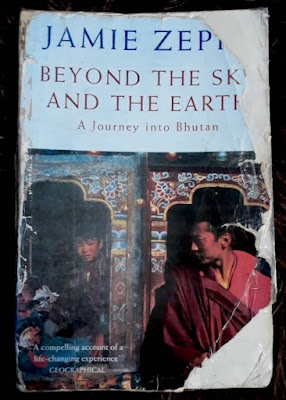
Beyond the Sky and the Earth: Book Review

Beyond the Sky and the Earth

I first read Beyond the Sky and the Earth: A Journey into Bhutan in 2008 soon after I had graduated from Sherubtse College. I faintly remember some fascinating moments of the book: Jamie riding on the ‘Vomit Comet’, Jamie teaching English in a remote school in Pema Gatshel, night hunting experience in Kanglung, and how Tshewang forgets his underwear in a bush where they have just made love. 


I read the book again, this time particularly to know how a foreigner sees and understands Bhutan and the way of life here and what made her write this beautiful memoir. Moreover, just sometimes back, I met Mr Tshewang, the lover of Jamie, at the automobile workshop in Thimphu where I had a quick conversation with him. 


Tshewang appears to me exactly what the author has described in the book: “He has a handsome face: high cheekbones, a luscious mouth” (pg. 244), “worldly and extremely well-read” (pg. 245), and “has a quicksilver smile and very mischievous eyes” (Pg. 245). The only difference, even after thirty years, is that he now has long grey hair and a wrinkled face. 


“I came here to fix my alto car,” he told me in a jovial tone. “Tomorrow I will be traveling to eastern Bhutan to drop off a lama.” 


Then we talked about his works and my writings. It’s quite a strange feeling to talk to someone that I read a great part of his life in a book. 


Jamie Zeppa came to Bhutan in 1989 to teach through the World University Service of Canada, where she spent three and half years teaching English at Pema Gatshel Middle Secondary School and Sherubtse College. After that, she married Tshewang, with whom they have a son, Pema Dorji, and lived in Thimphu until 1998. 


Jamie initially perceives Bhutan as a “remote”, secluded, “small Tantric Buddhist Kingdom in the Eastern Himalayas”, and mountainous with too difficult terrain. When she arrives in Bhutan, at the age of twenty-four, she seems lonely, certainly unhappy, regretful of her decision, and thoroughly tired and bitter. She has to go through endless difficulties living alone within an alien culture far from the security of her so-called ‘home’ in Canada (which she later starts calling Bhutan ‘home’ too).


However, this feeling gradually evaporates as she delves deeper into Bhutanese society, exploring the overwhelming beauty of Bhutan’s landscape, interacting with innocent crude people, knowing the warmth of Bhutanese culture, embracing faith and falling in love. 


When Jamie reaches Sherubtse College, she has already fallen in love with Bhutan. She tells: “I have fallen into this world the way you fall into sleep, tumbling through layers of darkness into full dream. The way you fall in love.” 


Over time, she finds solace and deep refuge in Buddhism, and she eventually converts to Buddhism and feels “Blessed to be here.”


She states that love with Tshewang is ‘a big reason’ why she has extended her stay in Bhutan. Had there been no entry of Tshewang into her life, this book would not be this exciting and enthralling. 


This memoir is more than a usual travel book; it’s a love story. And her romance with Tshewang, which is supposed to be forbidden, is told in a brutally honest manner. 


“He is a warm and ardent lover, completely uninhabited. It is as if we have been lovers for years…I am safe here, with him; in the middle of the biggest risk I have ever taken in my life, I am safe,” she says happily.


The book also provides astute assessments of outdated methods of teaching in schools, gender mainstreaming, the political situation of Bhutan, and the Bhutanese nature of just following directives and not being critical and vocal. But she says all this in an honest and humorous tone, which makes her observations very interesting and sensible. 


Her book also takes me to many beautiful places in Bhutan that I have not been to yet: Jomolhari, a holy lake above Khaling, and Yurung in Pema Gatshel. I must say—among the books written on Bhutan that I read—Beyond the Sky and the Earth is the best. But I am a little disappointed with Jamie Zeppa because she has written only two books. 

Tuesday, December 28, 2021

A Forgotten Essay

I found this essay in my email inbox today while cleaning up my Gmail account. I wrote it in 2015 for an essay competition titled, “Complementarities between Buddhism and Hinduism practised in Bhutan”. And I didn't win it, not even the consolation prizes. This is what every aspiring writer goes through, I knew it then. 

But still, this particular story gives me some meaning of life and it portrays my belief, my journey, my inner voice, and my identity. So to say, I feel a lot of pain just to discard it forever and this piece of my heart will remain here, on my blog. Here it is:

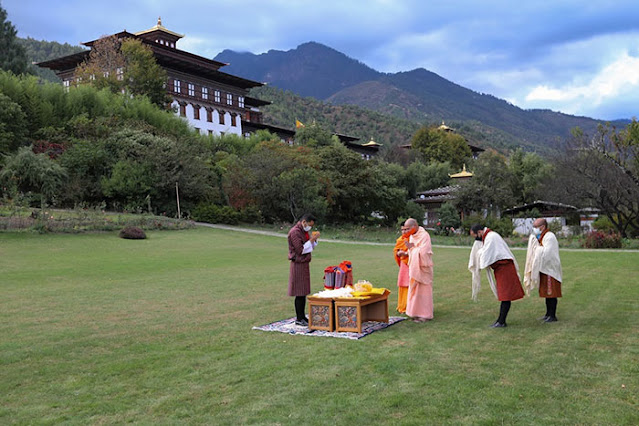
                        His Majesty The King grants Dashain Tika. PC Kuensel


I was born Hindu in Southern Bhutan. Ever since my birth, I was brought up as a typical Hindu child worshipping Hindu gods and goddesses, practising the rites and rituals, and ardently following Hindu customs. In fact, I have practised and enjoyed my faith independently and freely.  

Bhutan, however, is deeply a Buddhist kingdom where the majority of the people practise the Drukpa Kagyudpa tradition of Mahayana Buddhism. Since my school days, I was often introduced to the teachings of Buddha and Buddhist spiritual practices. I have visited and prayed in many Buddhist monasteries and also actively attended the rituals and ceremonies. 


Surprisingly, my parents and the Hindu community never objected to me from doing so; neither did it affect my faith. Moreover, I didn’t feel any indications of discrimination or imposition of Drukpa Kagyudpa beliefs on me. Instead, it provided me an opportunity to enhance my worldview and knowledge on spirituality and respect for religion. Similarly, my Buddhist friends attended my family rituals and ceremonies and they always enjoyed and appreciated being involved. 


In our society, the way these two religions are practised uniquely complements each other by sharing a sacred relationship and respect. They show a great deal of kindness and respect to each other’s faith and culture by exhibiting religious tolerance and a non-judgmental attitude. 

This is attributed to numerous complementarities between these two Dharmic traditions are practised in Bhutan. Firstly, it’s the ideologies and religious practices of the two religions; secondly, our country’s policies and development; thirdly, our beloved Fourth and Fifth Druk Gyalpo’s unwavering support; and lastly, the social harmony and respect. 

From a very early age, Buddhist and Hindu traditions peacefully co-existed for each other sharing parallel beliefs and ideologies and Bhutan is one particular nation where these two Dharmas have continued to flourish complementing and extending favors to one another. In their teachings, both religions retain the centrality of dharma and it forms a basis for beliefs and practices. Also, both emphasize righteousness and compassion to all sentient beings and it is the virtue on which the religions are based upon. 

Furthermore, they share several common practices of rites such as the purification, consecration and baby showering rites, and prayers for ancestors and deceased. Interestingly, in Bhutan, it is common to see Buddhist monks performing some of these rites in Hindu families and vice versa. 

Both Buddhists and Hindus living in Bhutan believe in astrology. On a regular basis, they follow the practice of calculating auspicious dates for important events like marriages, starting a new business, agricultural activities, etc. Being Hindu myself, I have referred to Buddhist Zakar on several occasions and it helped me a lot. I have seen many Buddhists seeking help from Hindu astrologers too.  

The practitioners of these two religions see karma as the main causative factor behind rebirth in the world and they share similar views on Samsara and reincarnation. Therefore, we see the Buddhist and Hindu practitioners undergoing the spiritual practices of mediation, yoga, and concentration to attain enlightenment.  

A series of government policies aiming at systematic harmonization of the religions and cultural cohesion are being enacted and enforced in Bhutan. The Hindu Dharma Samudaya of Bhutan (HDSB) legally represents the Bhutanese Hindus, which constitute a quarter of Bhutan’s population and is registered with the Chhoedey Lhentshog (as provisioned in Religious Organizations Act of Bhutan 2007). Moreover, the Commission is represented by an eminent Hindu Pundit.  

This clearly indicates the policies and law enforcement of our government are not only designed toward freedom and protection of religious identity for Hindus in Bhutan, but the Royal Government of Bhutan is already recognizing the complementarities between these two religions and the importance of Hinduism and its religious practices for the growth of spiritual heritage of Bhutan. 

Even in the democratic setting of our government, at least two elected Hindu representatives have been appointed every time as the Ministers who represent Lhotshams in the cabinet. This particular practice truly demonstrates that the followers of Buddhism and Hinduism can work together even in the country’s highest political setting without disapproval and discredit. 

Several worshipping establishments were developed for the Hindus. In Thimphu, a permanent Hindu Temple was constructed recently. The consecration of the temple was conducted in the presence of Je Khenpo, the Chief Abbot of the Central Monastic Body of Bhutan, and both Buddhist and Hindu ceremonies were held. 

Instead of feeling threatened by the existence of Hinduism in Bhutan, the Buddhists have extended many favors to the development of Hinduism and one can understand it when the Je Khenpo consecrated the Hindu Temple. Also, the Sivalaya Mandir in Samtse was constructed under the command of His Majesty the King.  

The Hindus celebrate different festivals and most importantly, Dashain has been declared a national holiday in Bhutan since 1980. Every year, His Majesty the King of Bhutan, the Buddhist King, celebrates the Dashain with the Hindu community by receiving Tikka from Hindu Pundit. 

In 2011, the Druk Gyalpo and Gyaltsuen came to the Durga Mandir in Thimphu after the marriage proceedings in Punakha and the royal couple underwent the Hindu marriage ceremony. This shows that there is a great level of complementary between Buddhism and Hinduism practices and the Druk Gyalpo himself continues to revere Hinduism by being the real patron of religious tolerance. 

Lastly, the Constitution of the Kingdom of Bhutan states, “Buddhism is the spiritual heritage of Bhutan…” However, a book titled, ‘The Constitution of Bhutan-Principles and philosophies’ by Lyonpo Sonam Tobgye explains that, “It doesn’t compel people of other faith towards conversion to a monolith faith…Rather, our spiritual heritage is simply based on our history, traditions and beliefs.” Truly said, in Bhutan, Hinduism shares many significant complementarities with Buddhism and it only supplements our cultural diversity, enhances the growth of social harmony among the people, and enriches our spiritual heritage.